Hokusai's Great Wave explained: the real title of Kanagawa oki nami ura, its two blues and how many prints survive
Key points
- "The Great Wave" is an English nickname. The title printed in the upper left is Kanagawa oki nami ura, "Under the Wave off Kanagawa", one print in Katsushika Hokusai's (1760–1849) series Thirty-six Views of Mount Fuji.
- It is a woodblock print, not a one-off painting. Thousands of copies were printed; the Art Institute of Chicago says about 100 original prints are thought to survive.
- Its blues combine traditional Japanese indigo with Prussian blue, a pigment imported from Europe.
It is one of the best-known works of Japanese art anywhere, yet "The Great Wave" is only its English nickname. The title printed in the cartouche at upper left is Kanagawa oki nami ura, "Under the Wave off Kanagawa". Its maker, Katsushika Hokusai (1760–1849), was born and died in Edo, the city now called Tokyo. The Metropolitan Museum of Art dates the print to about 1830–32 and the Art Institute of Chicago to 1830/33. At roughly 25 by 38 centimetres, it is far smaller than most people expect.
It is also not a single painting but a woodblock print. According to the Art Institute of Chicago, thousands of copies were printed over many years, some after Hokusai's death, and about 100 original prints are thought to survive. That is why the "real" Great Wave hangs in many museums at once: the Art Institute owns three impressions, and the Met holds several. The publisher was Nishimuraya Yohachi.
The image belongs to Thirty-six Views of Mount Fuji (Fugaku sanjūrokkei), a series showing the mountain from different places. Hokusai began it in 1830, at the age of 70, and ten more designs were later added to the original 36. Fuji is the small triangle in the hollow of the wave. Because Japanese is read from right to left, the Art Institute notes, the print's first viewers would have met the rowers in the boats first and only then the wave about to break over them.
The striking blue is in fact two blues. One is indigo, long used in Japan. The other is Prussian blue, known at the time as Berlin blue, a pigment invented in Europe in 1706, imported to Japan and newly affordable when the series was made. Scientific analysis at the Met has found both in the print.
Its reach in the West was wide. The composer Claude Debussy owned a copy, and his orchestral work La Mer (1905) is said to have been inspired by it. Vincent van Gogh, in a letter of 8 September 1888, described its waves as claws.
Seeing one in person takes planning. Woodblock colours fade in light, so the Art Institute shows its impressions for only about three to four months every five years, and the Met rotates different impressions on and off view. The pale pink of the sky has faded in many surviving copies. Before travelling to see the Great Wave, check whether the museum that owns one actually has it on display.
Details
- Title
- Kanagawa oki nami ura (Under the Wave off Kanagawa), from Thirty-six Views of Mount Fuji
- Artist
- Katsushika Hokusai (1760–1849)
- Date
- c. 1830–32 (The Met) / 1830/33 (Art Institute of Chicago)
- Medium
- Colour woodblock print
- Size
- About 25 × 38 cm
- Publisher
- Nishimuraya Yohachi
- Surviving
- About 100 original prints are thought to survive (Art Institute of Chicago)
Japan, in a word
- 神奈川沖浪裏 Kanagawa oki nami ura
- The actual title of "The Great Wave", meaning "Under the Wave off Kanagawa". It is printed in the cartouche at the upper left of the print.
- 富嶽三十六景 Fugaku sanjūrokkei
- "Thirty-six Views of Mount Fuji": the series of woodblock prints of Mount Fuji that Katsushika Hokusai began in 1830, aged 70. Ten more designs were later added to the 36 of the title.
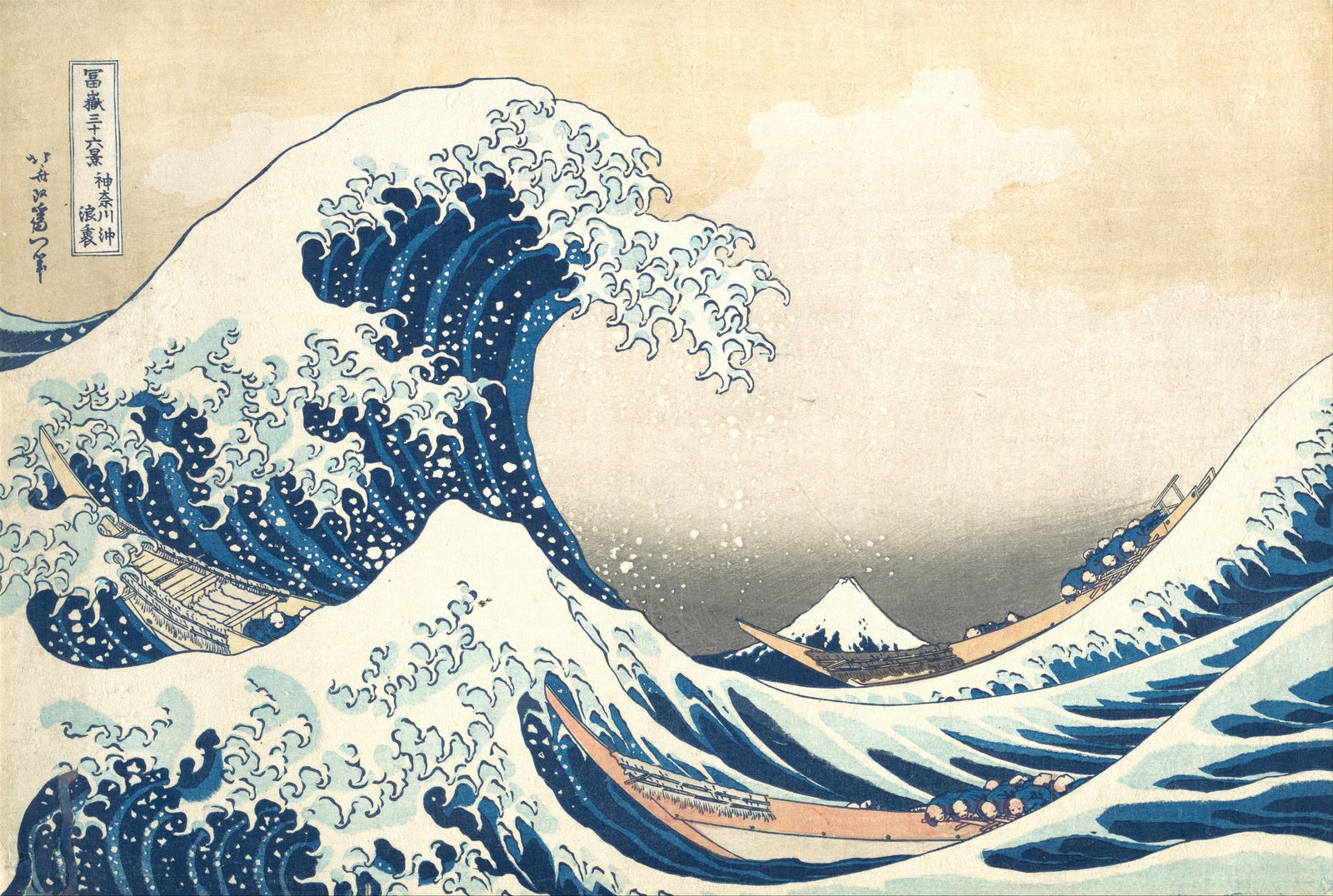
Katsushika Hokusai, Under the Wave off Kanagawa (Kanagawa oki nami ura), from the series Thirty-six Views of Mount Fuji, c. 1830–32. The Metropolitan Museum of Art. The Metropolitan Museum of Art / Public domain